

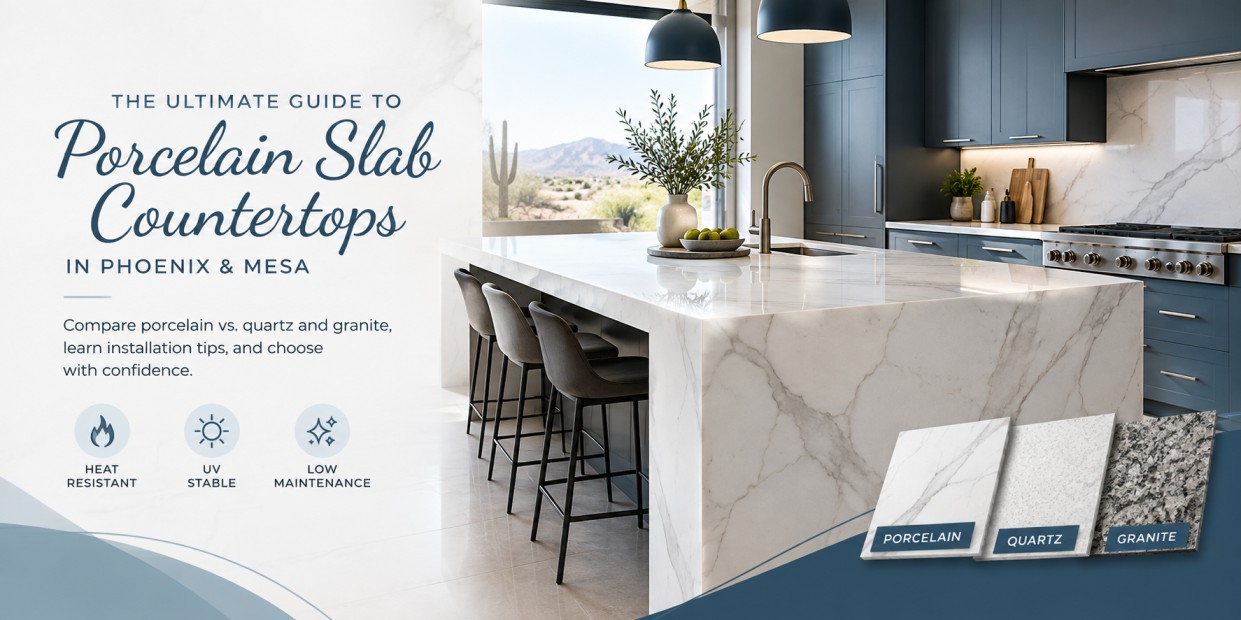
Perhaps you are planning a kitchen renovation in Mesa or Phoenix, and porcelain slabs have been coming up in your conversations or thoughts quite a lot. Your neighbor just installed them, and Instagram is not stopping the mouthwatering images of seamless waterfall islands that you see. So now you’re not sure if porcelain slab countertop installation is suitable for your home or not.
Imagine we are sitting in our Mesa shop having a cup of coffee, and you have just dropped by. We will have a simple chat about it, no technical or salestalk. We will just focus on what you really need to know to make an informed decision about those large, gorgeous slabs.
Why Everyone’s Suddenly Talking About Porcelain
That stunning white quartz backsplash installation that you fell in love with in the showroom? It can get yellow after you are exposed to that west-facing window for a few Arizona summers. Granite is a very strong material, however, those seams are a place where dirt gets trapped and the pattern can also become quite overwhelmed.
Porcelain slabs are the player in the game that has a lot of potential. They are not a brand new invention as Europe is quite advanced in their adoption of them, but it’s only now that they have really caught on in the United States because they really address the issues that we have here in the desert.
If you make a mistake, you are going to have a $5, 000 broken island. If you do it right, you will have the counters that require the minimum amount of maintenance while being the most heat-resistant ones in your Gilbert culdesac.
Porcelain vs. Quartz vs. Granite: The Desert Homeowner’s Breakdown
Let’s get real about how porcelain stacks up. We fabricate and install all three at our shop, so we’re not here to bash quartz countertop installation or granite. They each win in different situations.
| Feature | Porcelain Slab | Quartz | Granite |
| Heat Resistance | Wins. Put a hot pan down, no problem. We’ve tested this at 900°F+ | Okay. Brief contact fine, but trivets are smart | Great. Natural stone handles heat well |
| UV/ Sunlight | Won’t fade. Perfect for Phoenix kitchens with big windows | Can yellow over time with direct AZ sun | Colorstable. No issues |
| Seams | Minimal. We can do a 10ft island with zero seams | 23 slabs for large kitchens = seams | Seams expected, though we colormatch epoxy |
| Chip/Crack Risk | More brittle during install. Needs expert handling | Very forgiving | Strong, but corners can chip |
| Maintenance | Easiest. Nonporous, no sealing ever | Easy. Wipe and go, no sealing | Good. Seal once a year |
| Look | Ultramodern, thin profile, true marble looks | Consistent, lots of colors | Natural variation, classic |
How Porcelain Slab Countertop Installation Works
This is where a lot of contractors mess up. You can’t treat porcelain like stone. Here’s how we do it at our Mesa shop, step by step:
1. Measure + Template, Twice
Porcelain of large format is totally inflexible. Your cabinets should be flawlessly level within 1/8″ over a span of 10 feet. For every job, we use a laser to make a template. If your cabinets are uneven, we put in shims or you do the fixing first. Absolutely no exceptions. On one Queen Creek project, we did the template three times because the wall was out by ¾”. We prevented a $4, 200 slab from cracking.
2. Slab Selection + Layout
At the showroom, you will come and choose your very slab. In case of porcelain, the veins are a print and so we figure out the layout of the cuts to ensure the pattern remains continuous. That waterfall leg to be really lining up? We’re planning ahead.
3. Fabrication: The Scary Part
Porcelain is cut with wetness using diamond blades, gently, slowly. Before even moving the pieces, the edges are being strengthened. This is not work for a handyman with a grinder. One erroneous move and the sound will be like a gunshot that’s the slab cracking.
4. Installation Day
We first do a dry fit then use special suction frames to move the slab (no grabbing edges). The adhesive is really important too. We use a flexible epoxy specifically designed for porcelain as the house shifts in Arizona heat. Rigid glue will result in cracks six months later.
5. Seaming + Finishing
For seams (if you want one), we do a hairline, colormatched one, and then polish the edges, install your sink, and seal the perimeter. When using porcelain, there are no surface sealing steps at all.
Production of a porcelain slab countertop from templating to installation normally takes us about 23 weeks, depending on material presence. Experience has shown that trying to make it quick is the way to get callbacks.
Edge Profiles Explained: Ogee, Eased, Mitered & Waterfall
When it comes to porcelain, choosing the edge is even more essential than for any other kind of material. What is the reason? Because the majority of porcelain is only 12mm thick which is approximately the half of the thickness of quartz.
Although you have different choices, you should be aware that each one has its disadvantage:
- Eased Edge
- What it fully means: It’s a corner that is slightly rounded, it softens that sharp 90° corner
- Pros:It is the safest, cheapest option and a nice fit for any kind of style. Also, the kids won’t get hurt on it
- Cons: When using a thin material like porcelain, you inevitably highlight the thickness of the edge. It may give you a “plain” look if you desire a luxurious one
- Our verdict: This is the edge we resort to in 70% of the East Valley homes. It is neat and contemporary
- Mitered Edge
- What it fully means: The slabs are cut at 45° and two pieces are put together to give a perception of more thickness, usually 1.5″ or 2″
- Pros: You get the visual of a luxurious, thick piece but without it being heavy. Also, conceals the thin profile quite well
- Cons: Apart from being more expensive, you may see the seam if it’s not done well. Also a porcelain expert fabricator is needed
- Our verdict: A good investment for islands. We have a 12ft island in San Tan valley whose mitered top gives the impression of 3 cm marble
- Ogee Edge
- What it fully means: Elegant Scurve, rural and decorative
- Pros: Magnificent in Tuscan or old houses
- Cons: Very difficult to execute on thin porcelain without chipping. Will reveal every flaw. Not quite our favorite from a durability standpoint
- Our verdict: We convince 9/10 of our clients to go against this on porcelain. Granite is where it really shines
- Waterfall Edge
- Definition: The countertop is extended vertically down the cabinet sides to the floor.
- Advantages: Eyecatching. Perfect for Instagram. Conceals electrical appliances and increases the drama.
- Disadvantages: Pricey, as you need an extra slab + complicated installation. Veinmatching is a must.
- What we think: Seriously, porcelain is so much lighter that waterfalls are actually not that hard with it as quartz. And if you want “wow”, this is definitely it.
The thinner the material, the simpler your edge should be. Unless you’re doing a miter to fake thickness.
5 Local Tips From 25 Years in Arizona Kitchens
- Check the amount of sun you’re getting: Sunlight that comes through south and west facing windows tends to fade or damage surfaces. If, for some reason, the sun directly shines on the spot where you wash your hands, you’d better go with a porcelain or granite countertop instead of quartz, because those two materials handle sunlight better.
- Plan for natural changes in the weather:The structure of your house changes slightly due to varying humidity levels. A stiff, solid installation will crack. We use setting materials that are flexible for a very good reason.
- Homeowner associations can be very strict: Some East Valley homeowner associations (HOAs) require a licensed contractor for the installation of kitchen countertops. If it turns out that a permit is necessary, we take care of it.
- Don’t forget about dust: If you are planning to do your floor after your counters, make sure you let us know. Porcelain edges are susceptible to chipping if the tile guys get a little rough.
- Personally inspect the slabs: Don’t be fooled by a tiny sample piece. At our Mesa showroom, most of our slabs are on display with natural light so you can really see what you’re selecting.
Ready to See Porcelain in Person?
Look, porcelain isn’t for everyone. If you want the cheapest option or you love the depth of natural granite, we’ll tell you that. But if you want a countertop that laughs at Phoenix heat, needs zero maintenance, and gives you that seamless European look , porcelain slab countertop installation is hard to beat.
We’ve been fabricating inhouse in Mesa since 2009. My dad Clint started this shop, and now I’m running it with my sisters. We’ve made every mistake already, so you don’t have to.
Come visit us at Desert Sky Surfaces, 237 S. Date St, Mesa, AZ 85210. Touch the slabs. See a mitered edge up close. Ask us the hard questions. Or just call (480) 7585286 and we’ll talk you through your kitchen layout.
FAQs Phoenix Homeowners Ask Us Every Week
- Can porcelain slabs go outside in Arizona?
Yes , and they’re perfect for it. UVproof, heatproof, freeze/thaw stable. We’ve done BBQ islands in Queen Creek that look new after 4 summers. Just make sure your installer uses exterior-rated adhesives.
- Do porcelain countertops chip easily?
On the edge, they can if you slam a heavy pot. The face is crazy strong. We round edges slightly for this reason. It’s less chipprone than marble, about the same as quartz.
- How thick are porcelain slabs? Can I get a thick look?
Standard is 6mm or 12mm. We miter to build it up to 1.5” or 2” so it looks thick. You get the sleek look without the weight , critical for second-story condos in Phoenix.
- Can you do an undermount sink with porcelain?
Absolutely. We recommend it. The cutout gets reinforced and we use extra support brackets. Just don’t go with a farmhouse sink that’s heavier than 100 lbs without checking cabinet strength.
- Is porcelain slab installation DIY friendly?
I’ll be blunt: no. We’ve repaired three DIY attempts in Chandler this year. The slabs are too large, brittle, and expensive to learn on. A quartz countertop installation? Maybe. Porcelain? Call a pro who’s certified by the manufacturer.