
An informal, down-to-earth guide to the principal types of Granite Countertops, finishes, edges, installation process, and care recommendations for granite countertops, from the product and installation experience of Desert Sky Surfaces. Ideal for new homeowners who need to know about options before a showroom visit.
Quick rundown: why granite?
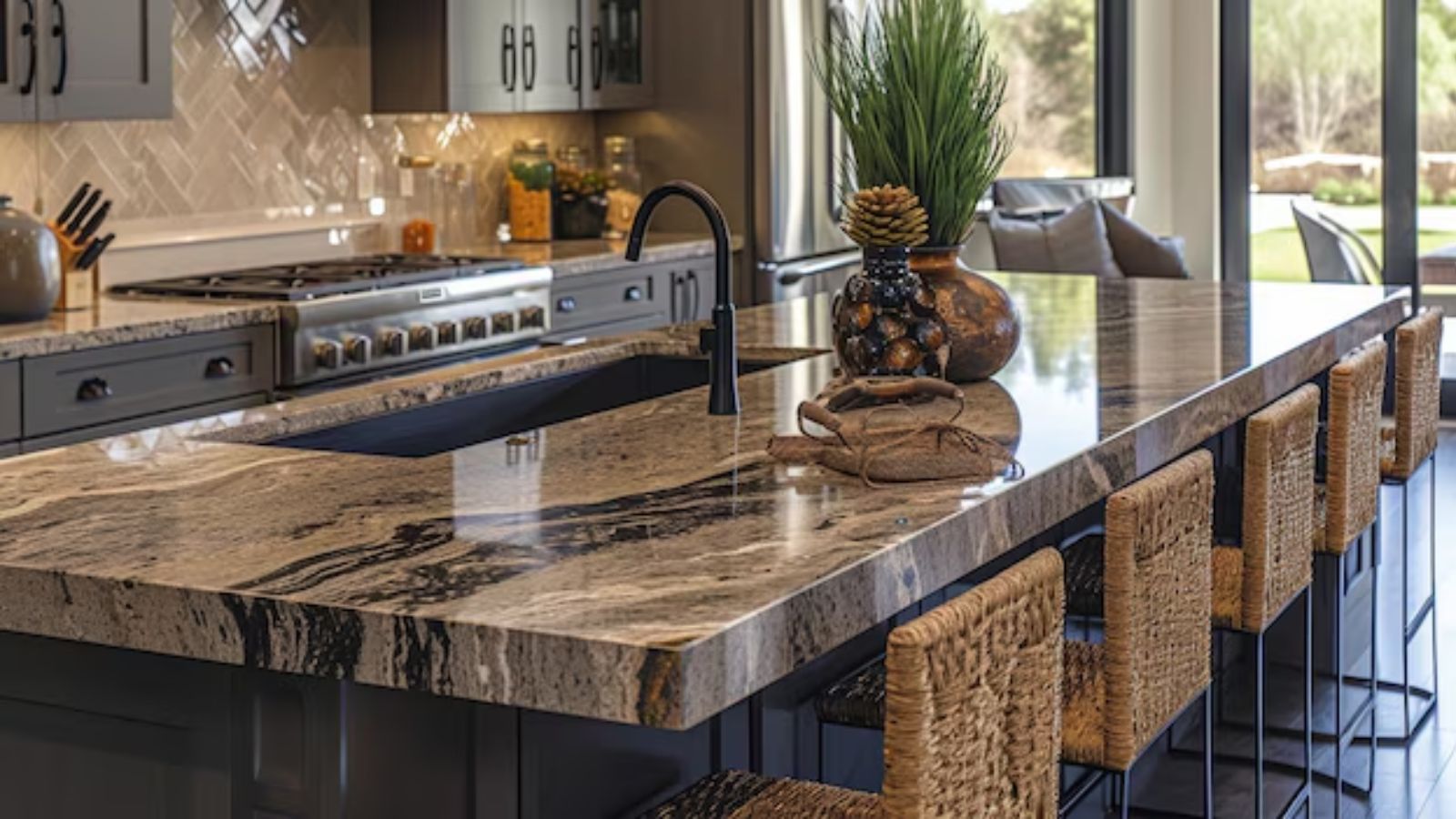
Granite is an entirely natural stone that is taken out in big blocks from the quarries. Slabs of granite are never the same, they differ from each other in terms of color, veining, and mineral pattern, so granite is truly original in every kitchen and bathroom. It is the toughest of all stones, withstands heat and scratches, and when well-sealed, it is highly suitable for high-traffic families.
How we categorize “types” of granite countertops (what the terms refer to)
When folks refer to “types of granite,” they typically are referring to one or more of these functional categories:
- Color & pattern families: Light (cream, white), medium (beiges, golds), dark (blacks, deep greens), and highly figured/exotic slabs with showy veining or large mineral spots. Since each slab is unique and natural, identical names may look quite different in reality.
- Finish (surface texture): Polished (high gloss), honed (matte), and leathered/brush-finished (slightly textured, soft sheen). The finish alters the appearance and how easy the stone is to clean.
- Edge profile: Final shape of the countertop edge (eased, bullnose, ogee, bevel, etc.). Edge selection impacts style and cost. Desert Sky Surfaces documents and fabricates prevalent edge profiles so you can select a look that suits your design.
- Domestic vs. exotic: “Domestic” typically means common local granites (less expensive); “exotic” means less common colors or patterns shipped in from farther away (more expensive, more dramatic look). See slabs in person to make comparisons.
Standard granite finishes: what they look/feel like
- Polished: Shiny, deep color, shimmery, traditional, makes the colors pop.
- Honed: Soft, non-shiny, muted, and contemporary.
- Leathered: Textured surface with soft sheen, hides fingerprints and water spots; suitable for rustic or busy kitchens.
Desert Sky Surfaces displays finish samples and project photos so you can visually see how a finish transforms the slab in actual installations.
Common countertop edge profiles (brief guide)
- Eased (straight): Clean, contemporary.
- Bullnose: Curved, softer look.
- Ogee: Fancy, classic, and formal.
- Bevel: Angled, slightly contemporary.
Edge selection affects price and appearance of thickness; choose an edge that suits your cabinetry and overall aesthetic. Most fabricators (including Desert Sky Surfaces) provide a variety of standard and custom profiles.
Installation: what to expect (step-by-step)
Desert Sky Surfaces and most professional fabricators will generally do the following steps:
- Consultation & slab selection: Visit the showroom and pick slabs (see the entire slab when it’s possible, photographs can be deceptive).
- Template: Technicians measure and create a template of your Granite Countertops to account for sinks, faucets, and appliances.
- Fabrication: The chosen slab is cut, seams are planned and finished, sink cutouts are made, and edges are profiled in the shop.
- Installation/setting: Stone is transported and installed on-site, installers level the cabinets, secure the tops, and finish seams. Many companies seal the stone during or after porcelain countertops installation.
- Final inspection & maintenance instructions: The team will present you with the completed work and recommend a maintenance and sealing schedule.
Care & maintenance (what starters need to know)
Sealing: Granite is permeable and needs to be sealed at installation and every now and then thereafter. Timing varies with stone porosity and family usage, typical recommended timeframes are every 6-12 months to every 1-2 years for certain stones.
Try a water drop test to determine whether the surface resists liquid; if it absorbs, reseal. Desert Sky Surfaces suggests sealing at install and will guide on re-sealing frequency.
- Daily maintenance: Mild dish soap and water or a cleaner that is appropriate for natural stone. Do not use harsh acidic cleaners (vinegar/lemon), and do not use abrasive pads.
- Stains & heat: Clean up spills immediately (oil and wine are common stain causes). Hot pans are better tolerated by granite than many other materials, but trivets must always be used for protection and to prevent thermal shock on extremely hot objects.
Cost factors & budget tips
Price is a function of:
- slab exotics and color/pattern (more expensive exotics),
- slab thickness and edge profile preference,
- square footage and intricacy (islands, backsplashes, cutouts),
- seam count and labor cost of the fabricator.
Meeting at a local showroom and requesting a written quote (most provide free quotes) provides the best budget estimate. Desert Sky Surfaces provides showroom visits and free quotes in the Mesa / East Valley region.
Selecting slabs in person practical advice
- Always see whole slabs (not pictures), differences between slabs are normal.
- Compare samples of cabinet paint or flooring to the slab under showroom lighting.
- Consider pattern matching if bookmatched veins or consistent flows on islands and backsplashes are desired, may add expense and be larger slabs.
- Inquire about leftovers if you require a compact countertop – some manufacturers offer remnant pieces discount.
FAQ
Q: Do I seal granite?
A: Yes, granite is porous and must be sealed upon countertop granite installation and re-sealed on a schedule based on the stone’s porosity and traffic.
Q: Is granite better than quartz?
A: They’re not identical: quartz countertop is made (non-porous, does not need sealing) and extremely uniform in appearance; granite is natural and unique, but typically needs sealing. Both extremely hard-wearing; the choice is style vs. consistency.
Q: Should I have granite installed myself?
A: Installing and cutting granite requires specialized tools, precise templating, and heavy lifting, a job best left to experienced pros to avoid damaging it and achieving proper seams and support.
Related Article: Stylish Quartz Countertop Ideas to Transform Your New Home
Conclusion
In case you reside in the Mesa / East Valley vicinity and are keen on viewing slabs, finishes, and edge options physically, Desert Sky Surfaces points out a showroom at 237 S. Date St., Mesa, AZ 85210 and provides free estimates as well as expert installation services. The decision to visit a showroom compared to just relying on samples is really significant when selecting the countertop granite installation, finishing touches, edges, and the precise slab you will be living with daily.
Short summary (for busy readers)
- Granite = natural, distinctive, long-lasting, requires sealing.
- Varieties are characterized by color/pattern, finish (polished, honed, leathered), edge profile, and domestic vs exotic.
- Shop at a showroom, look at full slabs, request a template and written quote, and trust professional installers for optimum results